‘Is this good for our county?’
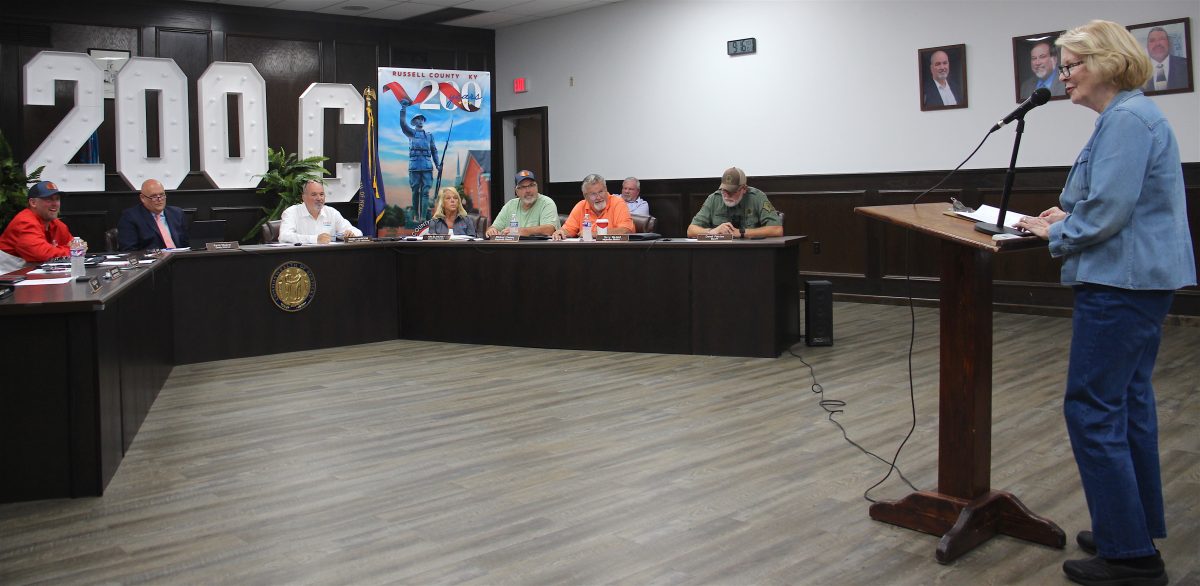
Former Russell County Extension Agent Linda Stephens addressed the Fiscal Court Monday. Stephens said she fears a proposed solar project would harm the community.
By Wade Daffron
TJ Editor
In a packed meeting including cheers, applause, impassioned pleas, and strong opinions, the Russell County Fiscal Court voted to consider an ordinance which would address future solar projects.
Monday, at the regular monthly meeting of the governing body, the court chose to pursue an ordinance which would require any future solar parks built within the county to possibly adhere to a designated “set back” from property lines, roadway, and waterways.
The action came after Round Trip Energy recently proposed building a 450-acre solar park in northern Russell County.
Combined with a previous plan, the “Mount Olive Solar Project,” (under another company) would involve up to 1,000 acres of land in the Mount Olive and Sano areas of Russell County.
With growing concerns, a group called Russell Countians Against Industrial Solar has been holding meetings, and also circulated a petition with over 800 signatures thus far.
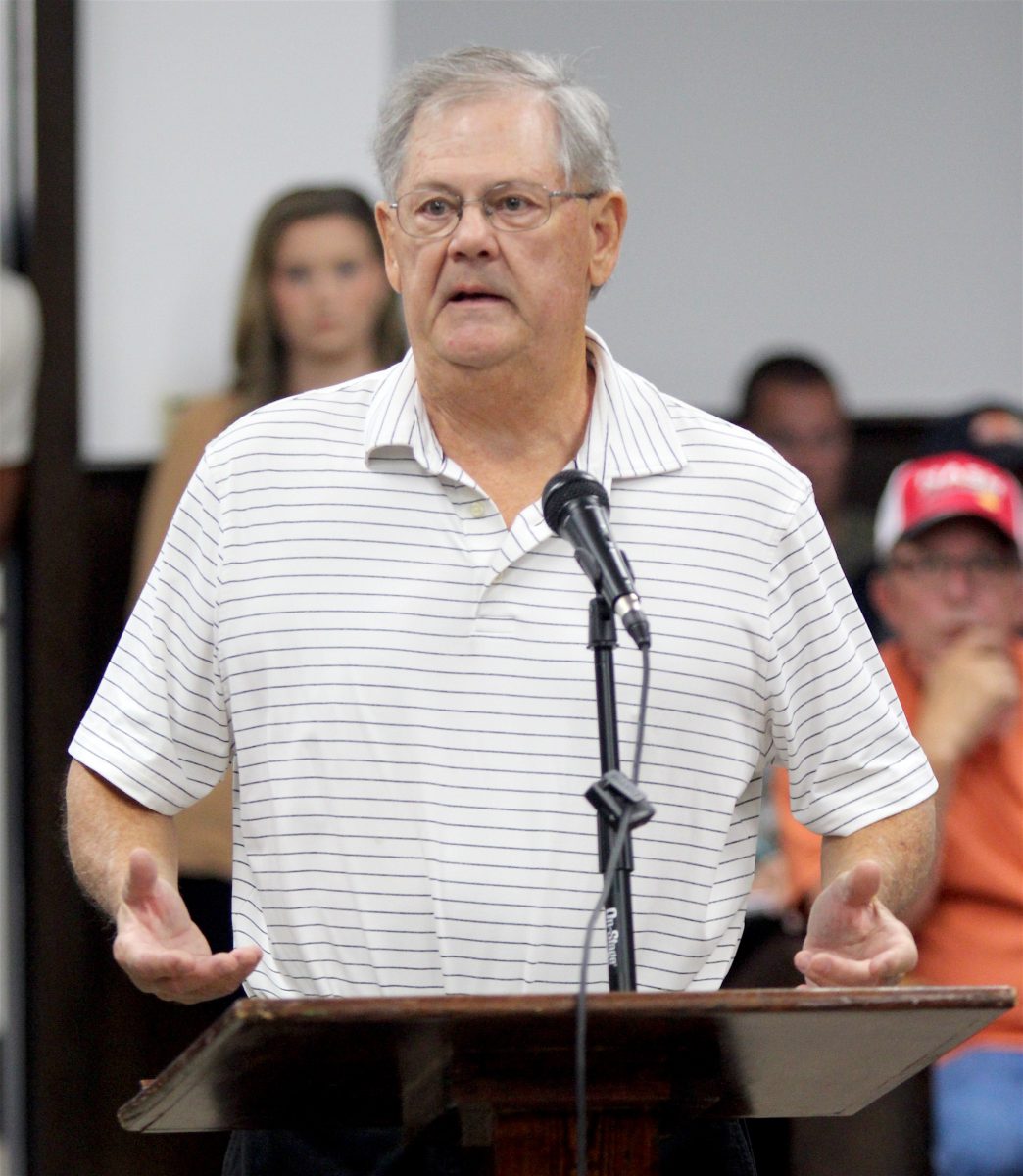
Well-known and respected Dr. Victor Cooper expressed his concerns about solar projects in his area.
The petition supports an ordinance or moratorium on solar projects in the county.
At the meeting earlier this week, several people spoke out against the most recent solar project.
Former Russell County Extension Agent Linda Stephens said a solar project would possibly “do harm.”
“Is this good for our county?” she asked the court.
Stephens said she felt a solar project would adversely affect local tax rates, property values, citizens, businesses, and the environment.
“There is no good in this,” she said.
Brian McElroy, owner of the Russell County Farm Store, addressed the court with concerns as both a business owner and a concerned citizen.
“As an agribusiness owner…I depend on farmers from our local area to support my business,” he said. “Acreage is important…and the loss of acreage is a continuing challenge, as is the loss of farming. That challenge is not going to go away. It comes at us from all angles.”
“When we consider taking agricultural land and turning it into an industrial enterprise, then we’ve got to consider an ordinance, consider restrictions,” he told the court.
McElroy said people who would be affected by the solar project “need someone to take a stand for them.”
After other citizens spoke, Round Trip Energy Executive Director Benjamin Levy addressed the court.

Round Trip Energy Executive Director Benjamin Levy spoke to the Russell County Fiscal Court earlier this week. Levy said a solar project has support within the community.
“This is a project we have actually been developing over the last four or five years,” he said. “There are, believe it or not, a lot of supporters of the project. This project is something that will be a net benefit to the county. We will all see a net benefit to the community and the neighbors nearby.”
Levy said the project would increase local tax revenue “significantly” and “stimulate the economy.”
He said he is aware of opposition, and expects the project “to be run through the ringer in the review process.”
Round Trip “has begun a process of reaching out to the community,” he said.
“We are in a pre-design state right now,” Levy said. “We would like to engage the community and the fiscal court and listen to feedback and concerns. We are really committed to working with the court and members of the community to address specific…concerns.”
Russell County Judge Executive Randy Marcum called for discussion among the court.
“We, as the fiscal court, cannot tell a farmer what to do with their land,” Fourth District Magistrate Steve Richardson said. “We don’t have that authority.”
(The solar project is located within Richardson’s district.)
“I’m 100 percent in favor of putting an ordinance in that they stay so far from the property lines,” he said. “The only thing I’m aware of that we can do is put an ordinance in to keep them so far off the lines (property, roadway and waterways).”
Marcum said the court could do an ordinance including a “set back” from lines or boundaries.
“I’m a firm believer in ‘If it ain’t broke, don’t go and try to fix it,’ ” Fifth District Magistrate Larry Skaggs said. “As far as I know, everybody in here has electricity. Personally, I don’t like this idea, I won’t stutter to tell you I’m against it. I’m gonna take care of my people. These are the people I live with, that I love, that I’ve been here with for years. I’m gonna listen to them.”
Skaggs’ comments were meant with a rousing round of applause.
“With that being said, I’m going to vote to put every restriction we legally can on it,” Skaggs followed.
Judge Marcum told the court there was “nothing we can do about the (earlier) Sano Project.”
“It’s already done,” he said.
Magistrate Richardson made a motion, seconded by Skaggs, to pursue an ordinance regarding future solar projects.
The motion was unanimously accepted among the court.
Magistrates will confer with Russell County Attorney Kevin Shearer about the content of the ordinance-which could include language requiring a 1,000 foot “set back” from existing property lines, roadways and waterways.
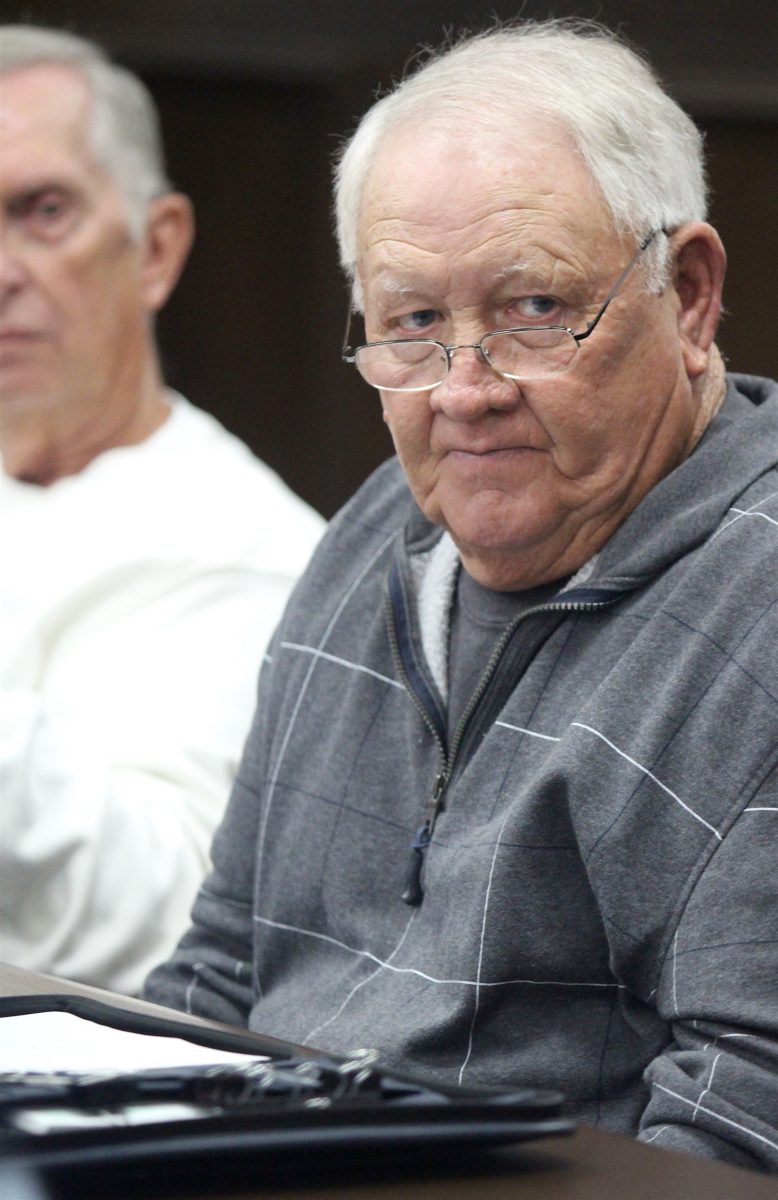
Fourth District Magistrate Steve Richardson, with Fifth District Magistrate Larry Skaggs in the background, listened to information at a meeting Monday. Both men made efforts toward an ordinance regulating future solar projects in the county.
Second District Magistrate Mickey Garner said the court could hold a special called meeting if needed as the ordinance advances.
Cameron Tiller, who has been instrumental in informational efforts against the project near his home, said the movement “is a ‘love thy neighbor’ campaign.”
“It just goes to show what can happen when the community comes together on a issue,” he said.